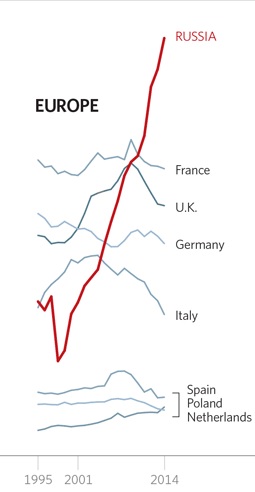
Militārie izdevumi Eiropā kopš Aukstā kara beigām
Argument #1: “The United States spends more than the next seven countries combined.” This is perhaps the most common argument used to support claims that the U.S. spends too much on national security. It is also not a particularly helpful argument for four reasons:
- U.S. national security spending has been dramatically declining for years.In 2011, according to the same data, the U.S. spent more than the next 13 countries combined.[4]In 2012, it was 10 countries.[5] In 2013, it was down to eight countries.[6] Finally, in 2014, it was down to seven countries.[7] The trend is clear.
- The U.S. spends more than the next few countries combined on a lot of things. For example, the U.S. spends more than the next nine countries combined on health care.[8]In 2012, Americans accounted for about one-third of the world’s total spending on entertainment.[9]Americans eat one and a half times more beef than all of the European Union countries combined.[10] While these comparisons do not pertain to national security, they show that the U.S. is a big spender in a lot of areas, not just security.
- The U.S. provides better training, equipment, and pay to its soldiers.Countries such as China and Russia pay their service members less in part because they can conscript a significant portion of their military.[11]Even more importantly, Americans believe that they should not send men and women into harm’s way without the best possible training and equipment. Other countries choose to invest less in equipping and training their individual service members, whether soldiers or fighter pilots.[12] Investing in the individual costs more, but it produces a higher-quality force and better prepares them for life outside the military.
- The U.S. preempts threats before they arrive at its shores.The U.S. military is designed to project power around the world so that it can deter or, if necessary, defeat potential threats before they reach the homeland. No other country is capable of protecting its interests around the world like the U.S., and sustaining a military force capable of worldwide power projection comes at a cost.
Argument #2: “Defense spending has grown too much in recent years.” Variations of this argument are used regularly with numerous time frames and numbers. One example claimed “explosive increases in military spending since 9/11.”[13] Another talked about a “165% increase between 1998 and 2011”[14] in military spending, and a third argued that defense spending “has doubled since 2001.”[15] All of these numbers are very different if understood in the proper context. Comparing national security spending with non-defense spending, putting it in the context of gross domestic product (GDP) and total government spending, or even just adjusting for inflation produces a much different picture.
- From 2001 through 2015, spending on social and economic programs dramatically outpaced spending on national security. In inflation-adjusted dollars, federal spending on social and economic programs increased by 61 percent between 2001 and 2015.[16]During the same period, national security spending increased by 38 percent.[17]
- The low point for post–Cold War national security spending was 1998, and 2011 was the high point.The “165% increase” relies on picking the outliers—the lowest and highest spending years—since the end of the Cold War and does not account for the whole story. Measuring spending from 1998 to 2015, instead of stopping in 2011, produces very different numbers. Over this longer term, national security spending increased by 43 percent in real terms, while social and economic spending increased by 79 percent.[18]
- National security spending is a small part of total government spending.The Department of Defense (DOD) went from 16 percent of total federal spending in 2001 to a peak of 21 percent in 2007 and back down to 15 percent in 2015.[19]If state and local government spending are included, national security comprises only 10 percent of total public spending.[20]
- National security is a small part of the U.S. economy. As a percentage of U.S. GDP, total national security spending went from 3 percent of GDP in 1998 to 2.9 percent in 2001 to a high of 4.7 percent in 2010 and fell to an estimated 3.3 percent in 2015.[21]Per these numbers, national security spending as a percentage of GDP has remained relatively low.
Argument #3: “The national debt is the biggest security threat.” Former Chairman of the Joint Chiefs of Staff Admiral Mike Mullen made this statement regularly when he was the top U.S. military officer, and he has continued to repeat it in retirement.[22] However, when asked about the greatest dangers to the United States, Mullen identifies nuclear weapons and cyberwarfare as the two existential threats facing the U.S. today.[23] The U.S. national debt is one of the most serious issues facing our nation, but it does not constitute a national security threat, and it does not mean the U.S. should stop spending on national security for several reasons:
- The national debt is a different kind of threat. It will not launch nuclear missiles or suicide attacks. The national debt is a significant drag on the economy and will make life much worse for future generations. However, the U.S. faces real and potentially deadly threats today that it needs to address. Islamic State (ISIS), Russia, China, and Iran will still be threats even if the U.S. were to redirect all national security spending into deficit reduction.
- The national debt hurts the U.S. economy, as do security threats. Most estimates put the economic cost of the terrorist attacks on September 11, 2001, between $50 billion and $100 billion.[24]Even without specific attacks, security threats can dampen markets or drive up energy costs. While full-fledged wars are hugely expensive in the human and direct financial costs, they also result in reduced trade and economic growth.[25]Security is expensive, but insecurity costs even more.
- Reducing security spending alone cannot fix the debt problem.From 2009 through 2013, the annual federal deficits exceeded the entire national security budget.[26]In 2015, the DOD represented 15 percent of total federal spending, and the Office of Management and Budget predicts that it will decline to 11.7 percent of total federal spending by 2020.[27] Federal revenue has averaged 17.3 percent of GDP for the past 35 years (1980–2014).[28] According to Congressional Budget Office estimates, federal spending on Social Security, health care, and interest on the federal debt will reach 17.6 percent of GDP in 2035, exceeding the historical revenue average without spending a single dollar for any other government function.[29] The largest factors contributing to the national debt are mandatory spending programs. Even if the U.S. does not spend another dollar on national security, the national debt would continue to grow.
Argument #4: “We have more aircraft carriers than the rest of the world combined.” Other variations of this argument include the size of the U.S. Air Force and the number of ships in the U.S. Navy. These statistics may be true, but are not a sound reason to cut investment in the U.S. military:
- The United States prefers the “away game.”The U.S. is fortunate to have large oceans between it and potential U.S. adversaries. If a conflict were to arise, the U.S. would rather fight on the far side of the ocean than on U.S. shores. This requires the ability to project power from the air and the sea. This ability to project power around the world also benefits the U.S. economy, which relies on international trade. Exports alone account for 13 percent of the U.S. GDP,[30]and 95 percent of U.S. foreign trade is seaborne.[31] A strong Navy is required to maintain the freedom of the commons and to ensure that maritime trade routes remain open and free.
- The size of the U.S. military should be based on America’s needs. The U.S. is a global power with global interests. To secure American interests responsibly, a sizable and capable military is a necessity. Historically, the U.S. military has been sized based on the potential for fighting two conflicts simultaneously. This ensures that if the U.S. is fighting one war, a second adversary cannot take advantage of the situation to launch an attack in another region.[32]
- The U.S. military is smaller than at any time since 9/11. Today, the Navy has 273 ships.[33]The Navy has not been this small since 1916. The Navy’s fleet today is 14 percent smaller than on 9/11.[34]In fiscal year (FY) 2016, the Army will fall below its size on 9/11. At 475,000 soldiers on the way down to 450,000 or fewer, the Army will be smaller than at any time since 1940. In 2015, the Air Force will have 12 percent fewer personnel than on 9/11[35] and 26 percent fewer aircraft.[36] In fact, the Air Force will have fewer planes than at any previous point in the history of the Air Force.
- There are other comparisons. The Chinese military already poses a significant challenge to the U.S. military. According to one assessment, China has 70 submarines to America’s 73, and China has 72 principal surface combatants to America’s 83.[37]According to another estimate, China’s navy is between 220 ships and 244 ships, excluding small coastal patrol craft.[38]As of today, the U.S. Navy stands at 273 ships.[39]
- China’s military is growing rapidly. In 2015, China’s military budget is expected to increase by 10.1 percent.[40]Meanwhile, the U.S. national security budget has declined by 1.2 percent. China’s enlarged budget will produce significant increases in military capability. One analyst has said, “China has built more warships and war planes than any other nation in 2012, in 2013, and in 2014, and it’s probably going to do so in 2015, 2016, and 2017.”[41]
Argument #5: “We are fighting terrorists in pickup trucks, not other nations.” Since the end of the Cold War, the United States has not faced the same sort of existential security threat. Fighting terrorists should be cheaper than fighting the Soviet Union. Once again, the truth is tougher:
- The U.S. needs both to fight terrorists and to deter potential adversaries, such as Russia and China.Russia’s invasions of Georgia and Crimea and the continued fighting in eastern Ukraine show that Russia is still a dangerous power. China is building man-made islands in the South China Sea. Iran and North Korea are dangerous threats, taking advantage of tumultuous regional dynamics. The U.S. needs to deter these countries while supporting ongoing operations against terrorists.
- The U.S. has cut national security spending since the Cold War.National security spending peaked in 1986 and 1987 at 6 percent of GDP and 28 percent of total federal spending. The “peace dividend” of the 1990s brought national security spending down to a low of 3 percent of GDP and 16 percent of federal spending. In 2015, the national security budget is 3.3 percent of GDP and 15.8 percent of federal spending.[42]While the threats facing the U.S. have changed since the Cold War, sufficient investment is still needed to secure the future.
- The security threats facing the U.S. are numerous and challenging.Dr. Henry Kissinger, one of the most respected foreign policy leaders in the country, told the Senate earlier this year, “[T]he United States has not faced a more diverse and complex array of crises since the end of the Second World War.”[43]The United States needs a diverse array of capabilities to deter and defeat these diverse and complex threats.
- Fighting terrorism and deterring major potential adversaries requires better intelligence.The national security budget includes the bulk of the funding for the intelligence agencies, which now need to focus on additional nations and on terrorists scattered around the globe.[44]
Argument #6: “The military wastes so much money, so Congress should just cut its budget.” The DOD certainly has wasteful spending that should be eliminated. However, finding and eliminating this wasteful spending takes strong oversight. Indiscriminately cutting budgets is self-defeating and counterproductive. Waste, fraud, and abuse need to be rooted out, but doing so takes hard work.
- Auditing the Department of Defense.The DOD needs to achieve a fully auditable financial system. Currently, the department is on a path to have fully auditable financial statements by the end of FY 2017.[45]Congress and senior DOD leaders should ensure that the DOD meets this timeline. At the same time, inspectors general and various criminal investigative organizations within the DOD already conduct targeted audits and criminal investigations.
- GAO High Risk List.The Government Accountability Office (GAO) releases a High Risk List every other year to highlight agencies and program areas that are vulnerable to fraud, waste, abuse, and mismanagement. The 2015 list highlighted a number of areas in the DOD, and Congress and senior DOD leaders need to address these areas.[46]
- Congress is part of the problem.While the DOD has numerous areas of waste, Congress is often a contributing factor. Congress has a history of opposing DOD proposals that could save money. Congress may oppose these proposals for good reasons, but often the opposition stems from parochial interests, not from good policy. Congress also makes it hard to manage programs efficiently by failing to provide stable and predictable funding.
- There is no line item for waste, fraud, and abuse.Identifying waste, fraud, and abuse takes work. Across-the-board cuts may produce savings, but they can also produce waste or long-term costs. To find and eliminate waste, the DOD needs stable funding, strong management, and the ability to hold decision makers accountable.
 vara bungas